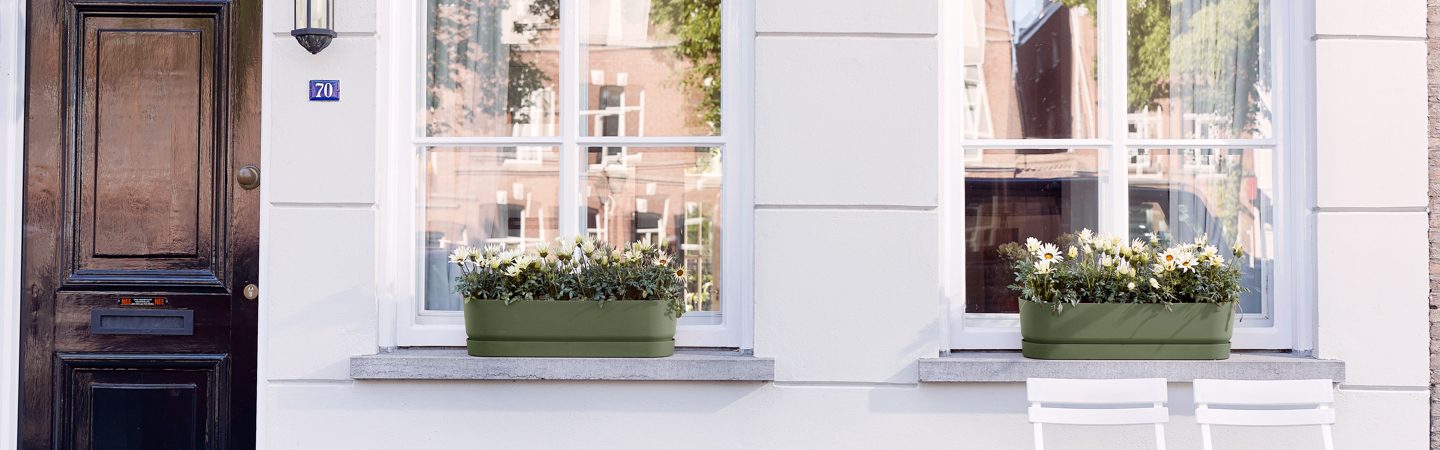
Oval Planters
An oval planter looks a little more relaxed than a strict square and a little more playful than a perfect circle. That is why an oval-shaped planter fits in surprisingly many spots: on your balcony, in the garden, on a wall or next to the front door. The soft lines give flowers, herbs and greenery a spot that feels unhurried. Simply choose a model that suits your space and your plants.
Which oval planter suits your balcony or garden?
With oval planters it is often about how and where you want to use them. One hangs beautifully on a balcony railing, another gets a spot on a wall or on a ledge where you want to add a bit more greenery without losing much space. There are models with hooks that you attach easily, but also variants that hang wider over a railing and are visible on both sides. That immediately creates more atmosphere, because you can see the flowers or herbs from both inside and outside.
Some models are especially handy for those who like convenience. A water reservoir saves time when it comes to care, especially on warmer days or when a planter gets a lot of sun. There are also oval planters and sets for sowing, growing seedlings or creating a small herb corner. That gives this shape something playful. You do not use it in just one way, but adapt it to what you want to grow and the spot you have in mind.
There is also plenty to choose from in colour and size. A soft shade can blend in nicely against a wall or railing, while a darker colour creates a bit more contrast with foliage and flowers. Finding the right oval-shaped planter therefore does not have to be difficult, but more a matter of seeing which one fits your balcony, wall or outdoor corner best.
Oval planters for moments, spots and seasons full of greenery
An oval planter can be placed in several spots in and around the home, especially if you like to vary things a little. The shape looks a bit friendlier than a sharp corner and connects beautifully with spots where you want to create atmosphere with greenery. On a balcony railing, an oval planter can immediately add more colour, while the same shape on a wall or on a narrow outdoor ledge feels a bit more airy. In a garden it works differently again. There, a planter can create a softer transition between tiles, wood and planting. The pleasant thing is that you can do something different with it each season, without the planter itself losing any of its charm.
A spring full of fresh colour
In spring, oval planters are very well suited for pansies, herbs or a light mix of young blooms. A planter in a soft colour then suits fresh greenery and the first flowers of the season beautifully.
Summer on the balcony or terrace
In summer it can get fuller and more exuberant. Think of a planter on the railing with trailing greenery, flowering plants or herbs close to the door. A darker colour often makes foliage and flowers stand out more strongly.
Autumn with warm tones
When things get a little quieter outside, you can choose plants with deeper foliage, graceful grasses or flowers in warmer colours. On a wall or near a seating area that immediately creates more atmosphere.
A winter full of greenery that stays
In winter, an oval planter does not have to remain empty. Think of winter-green plants that bring colour and life on days when everything outside looks a little barer. On a wall, near a front door or on a balcony, that keeps an outdoor spot feeling well-tended, even when the season is quieter.
What should you pay attention to when filling an oval planter?
A planter works best when you take a moment to think about the structure beforehand. Start with the planter itself. Is it standing firmly, is everything well secured and can excess water drain away properly? Then look at the filling. The order makes a difference. With a neat base layer, suitable potting soil and a logical arrangement you give plants a better start and keep the planter looking more proportionate. That already feels more pleasant during filling, and later you notice it again when caring for and maintaining the planter.
How do you approach that step by step?
Step 1: check the planter
First check that the planter is standing firmly or is properly mounted. Then check that the drainage is open and not blocked anywhere. That may seem like a small detail, but it prevents a lot of hassle once you start filling. A planter that stands crooked or retains water causes problems more quickly later with wet soil or an untidy structure.
Step 2: add a base layer
Start with a layer of hydro granules. That makes the base airier and helps excess water to drain away more effectively. Especially when a planter is filled completely, that is a pleasant first step. It creates a bit more separation between the base and the layer where the roots will grow. Please note: not all pots are suitable for use with hydro granules. Pots with a built-in water gauge or self-watering construction are not suitable in combination with the granules.
Step 3: choose the right potting soil
Then use potting soil that suits what you want to plant. Not every plant needs exactly the same base, so it helps to think about that briefly in advance. Good potting soil gives roots a better start and retains moisture in a pleasant way, without everything becoming too heavy or too compact.
Step 4: determine the layout first
Place the plants loosely in the planter before adding soil. That way you can still shift height, spacing and the position of each plant. In oval planters it often looks beautiful when the whole has a bit of spread and not everything stands in a perfectly straight row. Take your time with this, as it largely determines how the planter will look once finished.
Step 5: fill up gradually
Once you are happy with the layout, fill the soil around the plants. Work gradually from the outside in and press the soil lightly with your hands. The plants should stand firmly, but the soil does not need to be pressed down hard. Roots still need space to develop properly.
Step 6: water and take another look
After filling, give water and then leave the planter to settle for a moment. Often the soil settles a little further and only then can you see whether everything still looks right. Sometimes a small top-up is needed, or you might want to turn a plant just a little. That is entirely normal and is simply part of finishing the structure neatly.
With a calm and careful structure you lay the foundation for a planter that not only looks beautiful, but is also more pleasant to maintain later.
Which shape suits your spot best?
Oval planters have their own look, but sometimes during the choosing process you notice that a different shape suits the spot you want to style better. At elho you can therefore easily look further. Round planters often create a somewhat freer look and let greenery stand out beautifully in the space. Square planters connect well with corners, walls and furniture and give a spot a bit more structure. Oblong planters work well along a railing, on a narrower balcony or in a spot where you want several plants to come together.
That is precisely what makes comparing pleasant. You do not need to know in advance exactly which shape it should be. Sometimes oval fits immediately, sometimes a round or elongated variant turns out to work much better in your garden. At elho you will find different sizes, colours and models in all those shapes, making it easier to choose something that truly suits your space and your plants. So give yourself the space to look, to combine and to feel what is right. A plant always looks most beautiful in a spot that feels good.
Frequently asked questions about oval planters
What size oval planter fits best?
Look at the size of the plant and how much space the roots still need. A plant that stays in the same planter for longer or grows considerably needs more volume than a compact variety.
Where does an oval planter look its best?
An oval planter suits spots where you want to add softer lines. Think of a windowsill, narrow table, cabinet or a calm corner in the home where a round pot takes up too much space and a straight shape looks a little harder. The oval shape sits nicely in between. You keep a calm base, but the whole often feels a bit friendlier and more relaxed. That makes an oval planter very well suited when you want to put several plants together without it looking too full or too strict. Elho also explicitly mentions the windowsill and other narrow spots as a logical place for oval models.
Is an oval planter suitable for several plants together?
Yes, this shape often lends itself very well to that. In an oval planter you can more easily work with a small combination of foliage, colour and height. That makes the planter feel like a whole more quickly, rather than a few separate plants next to each other.
What makes an oval planter different from a round or square one?
An oval planter often feels a bit friendlier and more relaxed in the picture. A round shape looks very soft, square often looks a bit more clearly defined. Oval sits nicely in between. That makes this shape pleasant when you are looking for something that looks just a little different, without becoming too eye-catching.
How do you make sure oval planters look beautifully filled?
That often starts with calm in the structure. Choose a few plants that go well together rather than too many different varieties mixed together. A combination of a slightly taller plant, some fuller foliage and a lighter edge usually already creates a beautiful picture. That keeps the shape of the planter visible and the whole looks well-tended.